
Spiral bevel gears are widely used in mechanical transmission, such as in automotive differentials and industrial reducers. This type of gear, through an inclined tooth profile design, enables smoother power transmission and has a load-bearing capacity that is over 30% higher than that of spur gears. From the perspective of practical application, let’s break down six core parameters and three key control points.

Core Technical Parameters of Spiral Bevel Gears
Module: Determines the size of the gear
The module determines the size of the spiral bevel gear, with a common range of 3 to 8mm. The 5mm module is mostly used in automotive gearboxes, which can not only ensure strength but also control volume. Mining machinery will use a module of 8mm or more to deal with heavy load impacts. The selection of the module depends on the transmitted power. There is an empirical formula: module (mm) = (torque Nm × 1.5) square cube.
The combination of teeth: affects the speed ratio
The combination of teeth affects the speed ratio. The ratio of teeth of the driving and driven wheels is mostly between 1:1 and 1:4. The differential of off-road vehicles commonly uses a 10:40 gear combination to achieve a 4-fold torque amplification. Note that the number of teeth must be prime to avoid concentrated wear caused by frequent meshing of specific teeth. A certain agricultural machinery factory once adopted a 24:96 tooth combination, which led to regular tooth breakage three years later.
Helix Angle: Controls meshing characteristics
The helix Angle controls the meshing characteristics, and 35 ° -40 ° is the most common. The larger the Angle, the smoother the transmission, but the axial force will increase. A certain elevator factory adjusted the helix Angle from 38 ° to 42 °, reducing the vibration noise by 3 decibels, but shortening the bearing life by 15%. A balance needs to be struck between stability and component life. Under special working conditions, a variable helix Angle design is adopted. For instance, the helix angles at both ends of the spiral bevel gears in an oil drilling rig differ by 2 ° to compensate for thermal deformation.
Tooth width: Affects the contact area
The tooth width affects the contact area and is usually 8 to 12 times the module. The tooth width of the wind power gearbox reaches 15 times the module to cope with intermittent loads. Excessively wide tooth surfaces can lead to edge stress concentration. During a full-load test of a certain Marine gearbox, the 280mm tooth width gear showed end spalling. The problem disappeared after being changed back to 230mm.
Material selection: Match the requirements of the working conditions
Material selections of spiral bevel gears depends on the working conditions. Carburized alloy steel 20CrMnTi accounts for 70% of the market. In heavy-duty environments, 18Cr2Ni4WA is adopted, and the surface hardness can reach 60HRC. The gears of the vertical mill in a certain cement plant originally used 20CrMnTi and were replaced every six months. After being made of 25Cr2MoV steel containing molybdenum, the service life was extended to two years.
Accuracy grade: Determines the performance echelon
The precision grades are divided into three tiers. Agma grade 12 is used for general machinery, AGMA grade 14 is required for automotive gearboxes, and AGMA grade 16 is needed for precision machine tools. The measured accuracy of the spiral bevel gear of a certain CNC dividing plate did not meet the standard, resulting in a periodic error of 0.05mm in the processed parts. After replacing the AGMA16 grade gear, the error was reduced to 0.005mm.
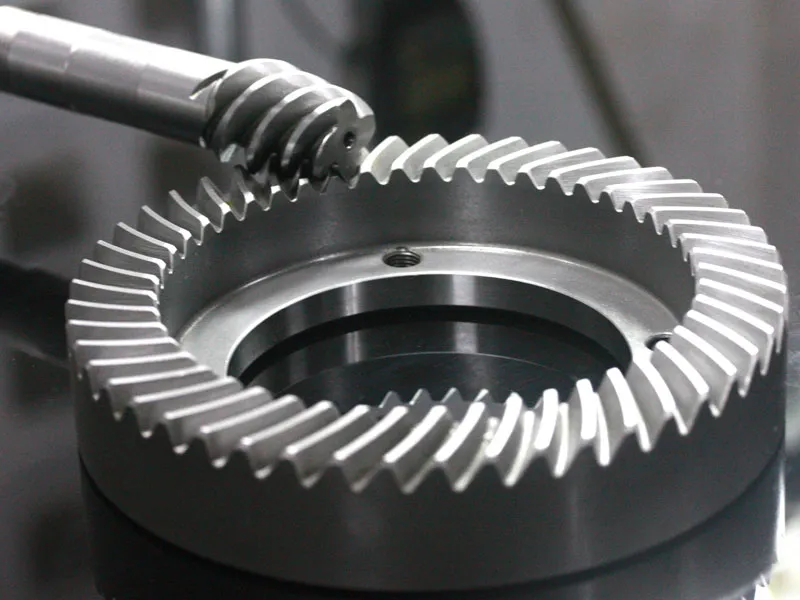
Critical Control Point of Spiral Bevel Gears
Heat treatment process: Ensure performance
The heat treatment process determines the performance. The depth of the carburized layer should be controlled at 15% to 20% of the modulus. The carburized layer of a certain gearbox gear was 1.2mm too deep, resulting in insufficient toughness at the core. Tooth breakage occurred during the bench test. It was changed to a 0.8mm carburized layer and combined with secondary tempering to pass the 200-hour durability test.
Lubrication parameters: Cannot be ignored
Lubrication parameters are often overlooked. When choosing viscosity, the PV value (pressure × linear velocity) should be taken into consideration. ISO VG68 oil is used for high-speed gears, and VG220 is used for low-speed heavy loads. The gearbox of the rolling mill in a certain steel plant mistakenly used low-viscosity oil. Three months later, adhesive damage occurred. After replacing the high-viscosity oil and adding extreme pressure agent, it returned to normal.
Installation and maintenance: Extend lifespan
Installation tolerance affects service life. The alignment error of the shafting should be less than 0.02mm/m. The bearings of a certain wind power gearbox were all damaged within half a year due to a 0.1mm/m misalignment caused by the settlement of the foundation. After adjustment with a laser alignment instrument, it has been running for three years without any abnormalities. The axial clearance should be controlled within 0.05-0.1mm. If it is too tight, it will generate heat; if it is too loose, it will cause impact.

Spiral Bevel Gears Maintenance and Fault Handling
Maintenance cycle: Dynamic adjustment
The maintenance cycle needs to be adjusted dynamically. For ordinary equipment, the oil should be changed every 2,000 hours, and in a dusty environment, it can be shortened to 500 hours. Abnormal ferrography data was found in the oil test of a certain cement mill gearbox. Replace it in advance to avoid gear damage. The alarm threshold for vibration monitoring was set at 4.5mm/s. A certain chemical plant arranged for maintenance when the vibration value reached 3.8mm/s and found early pitting corrosion on the tooth surface.
Abnormal noise: Classified processing
When encountering abnormal noise, it should be handled according to the situation: high-frequency howling is mostly due to insufficient precision, medium-frequency rumbling may be caused by misalignment of the shafting system, and intermittent abnormal noise should alert to broken teeth. A “clunk” sound was heard in the gearbox of a certain paper mill. After disassembly and inspection, it was found that there was an indentation on one of the tooth surfaces. The cause was a bump during installation. The abnormal noise disappeared after polishing.
Storage and assembly: Details determine success or failure
The storage environment should be protected from rust. When the humidity exceeds 60%, anti-rust oil must be applied. The gears in stock at a certain factory in the north rusted after half a year. The problem was solved by packaging them with vapor phase anti-rust film instead. Before assembly, demagnetization treatment is required. The residual magnetism will attract iron filings, which led to the early wear of the gearbox on the assembly line of a certain automobile factory.

 English
  Italian